Plan your wedding transport timeline backwards from the ceremony arrival time supplied by your venue or celebrant. Add realistic driving time, boarding, unloading and a separate contingency allowance. Then work forwards through photographs and reception travel. A timetable built around these tasks is more reliable than one based only on a navigation app.
Researched 20 October 2026. Statistics identify their reporting period.
Set the fixed arrival time first
Ask the ceremony team when each person must be present, not simply when the ceremony starts. There may be interviews, room access arrangements or a particular arrival order. Write these requirements at the top of the timeline. Where different people must arrive separately, treat those as separate deadlines.
Then identify the reception’s fixed points: drinks, group photographs, meal seating and speeches. Your car plan sits between these commitments. If the ceremony and reception share a venue, decide whether a short drive is actually wanted or whether the car is mainly for the arrival and photographs. Avoid adding a journey purely because it appears in someone else’s schedule.
Estimate travel for the correct road and time
In its release of 30 September 2026, the Department for Transport’s travel-time statistics put average delay on England’s Strategic Road Network at 10.8 seconds per vehicle per mile for the year ending June 2026, compared with free-flow conditions. That network average is not a suitable buffer for an individual wedding route: incidents and local streets can behave very differently.
Ask your operator to assess the actual route for the likely departure time and chosen vehicle. Check planned roadworks and local events nearer the date. For a wedding around Grantham, a route through a village, a town centre and an estate drive needs more thought than its mileage alone suggests. Keep the contingency allowance visible as its own line.

Allow for the moments around the drive
The car journey begins before the wheels move. Passengers need to leave the building, gather belongings and get seated. A full outfit, an older relative or a photographer capturing the departure can all make boarding slower. At the destination, allow time to stop safely, open doors and reach the correct entrance.
If one car is making several trips, include the empty return journey and turnaround. A ten-minute passenger transfer does not mean a second group can leave ten minutes later. Ask the driver to confirm the whole cycle and check whether the final trip still has a comfortable margin before the required arrival.
Build a worked schedule from agreed assumptions
The following is an illustration, not a recommended allowance for every wedding. Suppose the ceremony team requires arrival at 13:30, the operator estimates a 25-minute drive, and you agree 15 minutes of contingency. That gives a 12:50 departure. If boarding needs ten minutes, passengers should be ready at the collection point at 12:40.
Now add any staged departure photographs before 12:40 rather than borrowing from the driving margin. If the ceremony lasts 30 minutes from 14:00, discuss when congratulations and group pictures are likely to finish before fixing the next car departure. Replace each assumption with a time agreed by the people responsible; the arithmetic only works when the inputs are realistic.

Protect the photography window
Agree which pictures require the car and which can happen after it leaves. A photographer may want a doorway portrait, a departure frame and a quiet moment at the reception. Those are separate tasks and may require different positions. Put an agreed start and finish against the car-dependent photographs rather than simply writing photos into the timetable.
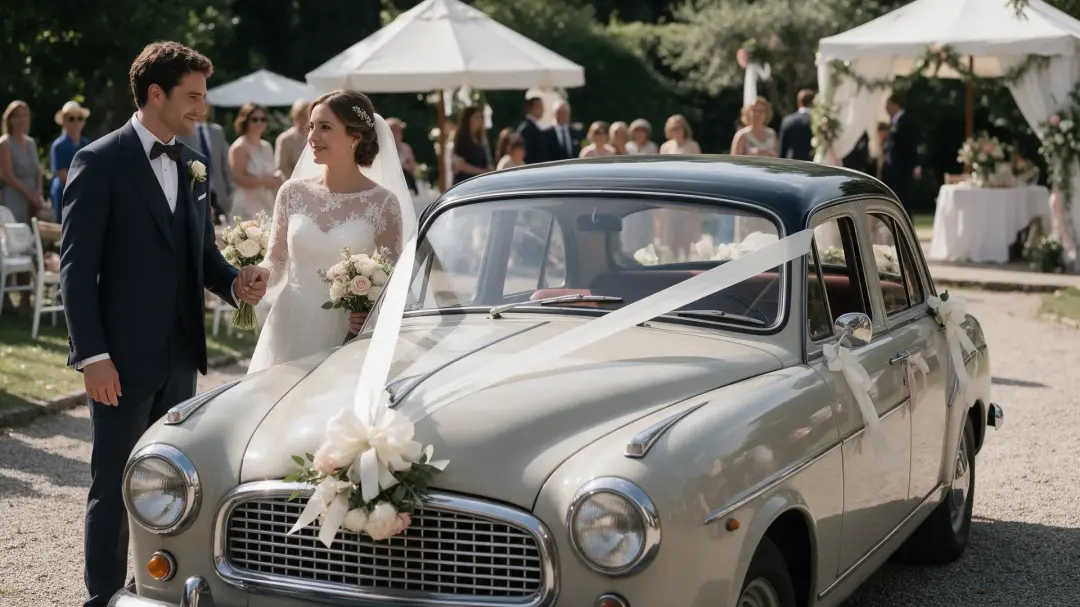
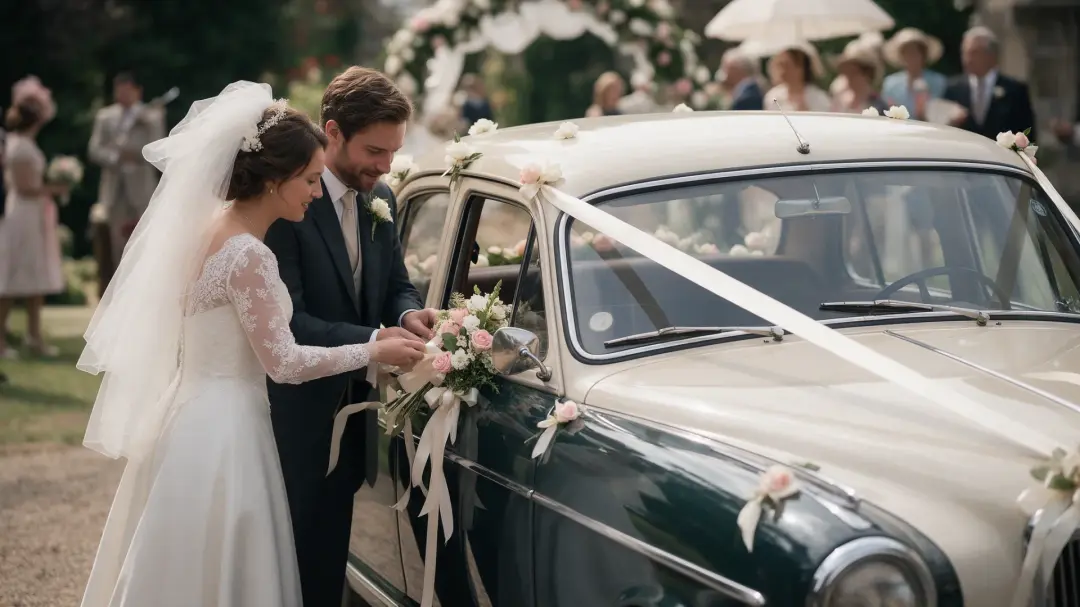
If the vehicle is central to your images, review the Classic Car Hire vehicles while planning the locations. Keep the driver involved so parking and repositioning are feasible. When the schedule gets tight, decide which pictures matter most instead of expecting the car, photographer and guests to wait indefinitely.
Issue a final running order and change rule
Give the coordinator a concise timeline showing ready time, departure, expected arrival, latest acceptable arrival and the next commitment. Include the exact collection point and who is travelling. Let passengers know that ready time means dressed, with belongings collected, at the agreed place; it is not the time to begin getting ready.
Add a simple change rule: who contacts the driver if preparations run late, who informs the ceremony team and which optional task can be shortened first. For arrangements with VintageCars.co.uk, confirm the final hire window as well as the journeys. A clear finish time avoids assuming that a late start automatically extends the booking.
Keep the timeline easy to scan
Separate the detailed supplier schedule from the short version sent to passengers. The driver and coordinator need route information and contingencies; passengers mainly need their ready time, collection point and contact person. A long document sent to everyone can hide the action each person must take.
Use consistent time notation and put the date on every version. Highlight only actual changes when you resend it. If the reception journey depends on the end of photographs, specify who gives the driver the instruction to depart. Clear responsibility is especially useful when the couple are away from their phones and several suppliers are working at once.
Summary
A usable transport timeline works backwards from fixed arrivals and forwards through the rest of the celebration. Separate driving, boarding, contingency and photography so none disappears inside a vague time slot. Share the final version with one coordinator and agree who will make decisions if timings move.